Hydrogen Peroxide Safety: What SPD Leaders Need to Know Now
Create a free account to access all information→Hydrogen peroxide has long been trusted for its sterilization power, but new findings show that short-term exposure risks may be under-recognized.
These white papers provide a scientific, practical review of exposure risk and emissions management to help sterile processing and infection prevention leaders create a safer, more consistent approach to hydrogen peroxide vapor safety for their teams.
Why this matters now?
- Safety standards are evolving to address short-term exposure risk
- Monitoring and control strategies are becoming more important where exposure may occur
- Hospitals that proactively evaluate and manage emissions can better support staff safety and readiness
-
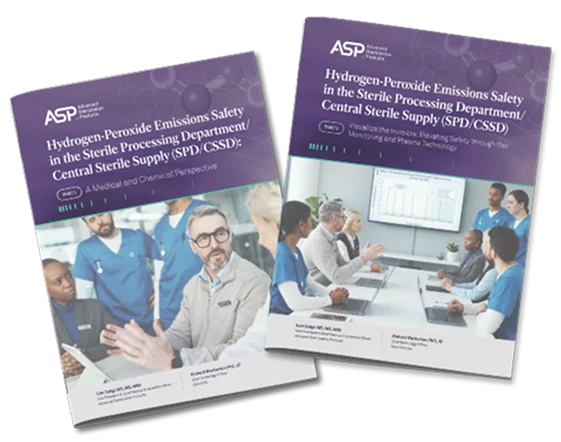
Part 1: Understanding hydrogen peroxide exposure risk
Inside you’ll learn:
- Why outdated hydrogen peroxide (H₂O₂) exposure limits may not adequately protect staff
- What happens when sterilizer doors open — short-term spikes up to 40 ppm
- How odorless hydrogen peroxide can create hidden risks
- Why global STEL regulations are shifting — and what they mean for your organization
- How vH₂O₂ + plasma technology helps reduce exposure during sterilizer door opening
-
Part 2: Managing peak hydrogen peroxide emissions
Inside you’ll learn:
- Why hydrogen peroxide emissions are peak-driven
- The limitations of relying on 8-hour averages alone
- Why “wait to vent” is a workaround—not a sustainable control
- How continuous monitoring supports visibility and trending
- How plasma technology helps reduce residual hydrogen peroxide before door opening
Authors


Helpful white-papers

References
PART 1
-
Dobson, G. P. (2020). Trauma of major surgery: A global problem that is not going away. International Journal of Surgery, 81, 47–54. https://doi.org/10.1016/j.ijsu.2020.07.017
-
News, H. P. (2023, April 26). Sterile Processing professionals profile. https://www.hpnonline.com/sterile-processing/article/53057147/may-2023-faststats
-
AAMI. (2024). ANSI/AAMI ST58:2024 – Chemical sterilization and high-level disinfection in health care facilities. https://webstore.ansi.org/standards/aami/ansiaamist582024
-
Schumb, W. C., Satterfield, C. N., & L.Wentworth, R. (1955). Hydrogen Peroxide. In American Chemical Society Monograph Series. Reinhold Publishing Corp.
-
(ATSDR), T. A. for T. S. and D. R. (2014). Medical Management Guidelines for Hydrogen Peroxide.pdf. https://www.webpoisoncontrol.org/-/media/files/pdf-for-article-dowloads-and-refs/medical-management-guidelines-forhydrogen-peroxide.pdf
-
ACGIH. (2025). TLV Chemical Substances Introduction – ACGIH. ACGIH Website. https://www.acgih.org/science/tlv-bei-guidelines/tlv-chemicalsubstances-introduction/
-
Oberst, F., Comstock, C., & Hackley, E. (1954). Inhalation Toxicity of Ninety Per Cent Hydrogen Peroxide Vapor. Archives of Environmental & Occupational Health, 10(4), 319–327. https://www.cabdirect.org/cabdirect/abstract/
-
Hygienists, A. C. of I. (1956). Transactions of the Eighteenth Annual Meeting of the American Conferences of Governmental Industrial Hygienists. ACGIH. https://www.acgih.org/wp-content/uploads/2023/07/1956.pdf
-
Mastrangelo, G., Zanibellato, R., Fedeli, U., Fadda, E., & Lange, J. (2005). Exposure to hydrogen peroxide at TLV level does not induce lung function changes: A longitudinal study. International Journal of Environmental Health Research, 15(4), 313–317. https://doi.org/10.1080/09603120500156003
-
(SCCP), S. C. on C. P. (2007). Opinion on hydrogen peroxide, in its free form or when released, in oral hygiene products and tooth whitening products. European Commission – Health & Consumer Protection DirectorateGeneral. https://ec.europa.eu/health/ph_risk/committees/04_sccp/docs/sccp_o_122.pdf
-
Ernstgård, L., Sjögren, B., & Johanson, G. (2012). Acute effects of exposure to vapors of hydrogen peroxide in humans. Toxicology Letters, 212(2), 222–227. https://doi.org/10.1016/j.toxlet.2012.05.025
-
Watt, B. E., Proudfoot, A. T., & Vale, J. A. (2004). Hydrogen Peroxide Poisoning. Toxicological Reviews, 23(1), 51–57. https://doi.org/10.2165/00139709-200423010-00006
-
Mastrangelo, G., Zanibellato, R., Fadda, E., Lange, J. H., Scoizzato, L., & Rylander, R. (2009). Exposure to Hydrogen Peroxide and Eye and Nose Symptoms Among Workers in a Beverage Processing Plant. Annals of Occupational Hygiene, 53(2), 161–165. https://doi.org/10.1093/annhyg/men077
-
GAGNAIRE, F., MARIGNAC, B., HECHT, G., & HÉRY, M. (2002). Sensory Irritation of Acetic Acid, Hydrogen Peroxide, Peroxyacetic acid and their Mixture in Mice. Annals of Occupational Hygiene, 46(1), 97–102. https://doi.org/10.1093/annhyg/mef005
-
HSE. (2020). EH40/2005 Workplace exposure limits (4th Ed.). The Stationary Office (TSO). https://www.hse.gov.uk/pubns/priced/eh40.pdf
-
WAC 296-841-20025_. Retrieved June 30, 2025, from https://app.leg.wa.gov/wac/default.aspx?cite=296-841-20025
-
HAWAII ADMINISTRATIVE RULES: TITLE 12. DEPARTMENT OF LABOR AND INDUSTRIAL RELATIONS, SUBTITLE 8, HAWAII OCCUPATIONAL SAFETY AND HEALTH DIVISION PART 2, GENERAL INDUSTRY STANDARDS CHAPTER 60, GENERAL SAFETY AND HEALTH REQUIREMENTS (Nos. 12–60). (n.d.). https://labor.hawaii.gov/hiosh/files/2012/12/12-60-General-SafetyHealth-Requirements.pdf
-
Health, N. I. for O. S. and. (2014, December 4). Hydrogen peroxide CDC NIOSH. https://www.cdc.gov/niosh/idlh/772841.html
-
OSHA. (n.d.). Permissible Exposure Limits – Annotated Tables. Retrieved August 11, 2025, from https://www.osha.gov/annotated-pels
-
Cornelia, R., & Warburton, P. R. (2017). Assessing hydrogen peroxide vapor exposure from hospital sterilizers. Journal of Occupational and Environmental Hygiene, 14(9), D150–D157. https://doi.org/10.1080/15459624.2017.1335401
-
Administration, N. O. and A. (2022). Threshold Limit Values (TLVs) NOAA. https://response.restoration.noaa.gov/oil-and-chemical-spills/chemicalspills/threshold-limit-values-tlvs
-
Kumar, & Kumar, V. (2020). Robbins & Cotran Pathologic Basis of Disease, 10th Edition -. https://evolve.elsevier.com/cs/product/9780323531139?role=student
-
Strayer, D. S., Saffitz, J. E., & Rubin, E. (2019). Rubin’s Pathology: Mechanisms of Human Disease by David S. Strayer MD, PhD, (8th ed.). Wolters Kluwer. https://shop.lww.com/Rubin-sPathology/p/9781496386144
-
Nelson, A. L., & Porter, L. (2023). Hydrogen Peroxide Toxicity. In NCBI Bookshelf. StatPearls Publishing.
-
Agency, U. H. S. (n.d.). Hydrogen peroxide: toxicological overview. Retrieved July 18, 2025, from https://www.gov.uk/government/publications/hydrogen-peroxide-properties-incident-management-and-toxicology/hydrogen-peroxide-toxicological-overview
-
Memarzadeh, F., Shamie, N., Gaster, R. N., & Chuck, R. S. (2004). Corneal and conjunctival toxicity from hydrogen peroxide A patient with chronic self-induced injury. Ophthalmology, 111(8), 1546–1549. https://doi.org/10.1016/j.ophtha.2004.01.027
-
Dumas, O., Varraso, R., Boggs, K. M., Quinot, C., Zock, J.-P., Henneberger, P. K., Speizer, F. E., Moual, N. L., & Camargo, C. A. (2019). Association of Occupational Exposure to Disinfectants With Incidence of Chronic Obstructive Pulmonary Disease Among US Female Nurses. JAMA Network Open, 2(10), e1913563. https://doi.org/10.1001/jamanetworkopen.2019.13563
-
Medicine, P. C. C.-N. L. of. (2025). National Center for Biotechnology Information (2025). PubChem Compound Summary for CID 6585, Peracetic Acid. https://pubchem.ncbi.nlm.nih.gov/compound/Peracetic-Acid
-
Pechacek, N., Osorio, M., Caudill, J., & Peterson, B. (2015). Evaluation of the toxicity data for peracetic acid in deriving occupational exposure limits: A minireview. Toxicology Letters, 233(1), 45–57. https://doi.org/10.1016/j.toxlet.2014.12.014
-
OSHA. (2021). PERACETIC ACID (Chemical Database No. 866). Occupational Safety and Health Administration. https://www.osha.gov/chemicaldata/866
-
OSHA. (2020). HYDROGEN PEROXIDE† (Chemical Database No. 630). Occupational Safety and Health Administration. https://www.osha.gov/chemicaldata/630
-
Weber, D. J., HICPAC, & Rutala, W. A. (2008). CDC Guidelines for disinfection and sterilization (pp. 1–163) [Guidelines]. CDC.
-
Society, A. cancer. (2024, September 10). Formaldehyde and Cancer Risk. Cancer.Org. https://www.cancer.org/cancer/risk-prevention/chemicals/formaldehyde.html
-
OSHA. (2021). FORMALDEHYDE‡ (Chemical Database No. 377). Occupational Safety and Health Administration. https://www.osha.gov/chemicaldata/377
-
NIOSH. (2019). Formaldehyde. CDC. https://www.cdc.gov/niosh/npg/npgd0293.html
-
Hogan, T. J., & Nalbone, J. T. (2016). TLV Development. Industrial Hygiene, 03(061). https://aeasseincludes.assp.org/professionalsafety/pastissues/061/03/F2_0316.pdf
-
EPA. (2016, September). Formaldehyde. https://www.epa.gov/sites/default/files/2016-09/documents/formaldehyde.pdf
-
ATSDR. (2022). Toxicological Profile for Ethylene Oxide. US Dept of Health and Human Services. https://www.atsdr.cdc.gov/toxprofiles/tp137.pdf
-
OSHA. (2024). ETHYLENE OXIDE‡ (No. 575). https://www.osha.gov/chemicaldata/575
-
NIOSH. (2014). Ethylene oxide. CDC. https://www.cdc.gov/niosh/idlh/75218.html
-
Levels., N. R. C. (US) C. on A. E. G. (2010). Ethylene Oxide Acute Exposure Guideline Levels – Acute Exposure Guideline Levels for Selected Airborne Chemicals – NCBI Books. In Acute Exposure GuidelineLevels for Selected Airborne Chemicals: Volume 9. (Vol. 9, p. 61). Washington (DC): National Academies Press (US). https://www.ncbi.nlm.nih.gov/books/NBK208167/#:~:text=The%20absolute%20odor%20detection%20level%20for%20ethylene,The%20odor%20recognition%20level%20is%20500%20ppm
-
Tijssen-Caan, W., & Visser, M. J. (2023). Overview of national occupational exposure limits for substances without a European occupational exposure limit This report contains an addendum d.d. 21-06-2023 on page 50 (No. RIVM letter report 2022-0123; pp. 1–60). National Institute for Public Health and the Environment, RIVM. https://www.rivm.nl/bibliotheek/rapporten/2022-0123.pdf
-
IMAP. (2014). Hydrogen peroxide (H2O2): Human health tier II assessment Preface. National Industrial Chemicals Notification and Assessment Scheme. https://www.industrialchemicals.gov.au/sites/default/files/Hydrogen%20peroxide%20%28H2O2%29_Human%20health%20tier%20II%20assessment.pdf
-
Mucci, N., Dugheri, S., Bonari, A., Farioli, A., Rapisarda, V., Garzaro, G., Cappelli, G., & Arcangeli, G. (2020). Health risk assessment related to hydrogen peroxide presence in the workplace atmosphere – analytical methods evaluation for an innovative monitoring protocol. International Journal of Occupational Medicine and Environmental Health, 33(2), 137–150. https://doi.org/10.13075/ijomeh.1896.01508
-
Woodruff, K. S., Pollitt, K., & Katten, T. M. S. of. (2025). Joint Commission Unveils Accreditation 360 Overhaul. National Law Review. https://natlawreview.com/article/joint-commissions-2025-accreditationoverhaul-what-healthcare-organizations-need
PART 2
-
ATSDR (Agency for Toxic Substances and Disease Registry). Medical Management Guidelines for Hydrogen Peroxide. US Department of Health and Human Services, 2014.
-
Cornelia R, Warburton PR. Assessing hydrogen peroxide vapor exposure from hospital sterilizers. J Occup Environ Hyg. 2017;14(9):D150–D157.
-
Dumas O, Varraso R, Boggs KM, et al. Association of Occupational Exposure to Disinfectants With Incidence of Chronic Obstructive Pulmonary Disease Among US Female Nurses. JAMA Netw Open. 2019;2(10):e1913563.
-
UK Health Security Agency. Hydrogen peroxide: toxicological overview.
-
Memarzadeh F, Shamie N, Gaster RN, Chuck RS. Corneal and conjunctival toxicity from hydrogen peroxide. Ophthalmology. 2004;111(8):1546-1549.
-
Mucci N, Dugheri S, Bonari A, et al. Health risk assessment related to hydrogen peroxide presence in the workplace atmosphere. Int J Occup Med Environ Health. 2020;33(2):137–150.
-
ANSI/AAMI ST58:2024—Chemical Sterilization and High-Level Disinfection in Health Care Facilities. Association for the Advancement of Medical Instrumentation, 2024.
-
(SCCP), S. C. on C. P. (2007). Opinion on hydrogen peroxide, in its free form or when released, in oral hygiene products and tooth whitening products. European Commission – Health & Consumer Protection DirectorateGeneral. https://ec.europa.eu/health/ph_risk/committees/04_sccp/docs/sccp_o_122.pdf
-
OSHA. (n.d.). Permissible Exposure Limits – Annotated Tables. Retrieved August 4, 2026, from https://www.osha.gov/annotated-pels
-
Occupational Safety and Health Administration. Hazard Communication Standard. 29 CFR 1910.1200. US Department of Labor.
-
The Joint Commission. Accreditation 360. https://www.jointcommission.org/en-us/accreditation/accreditation-360. Accessed 2025. | Woodruff KS, Pollitt K, Katten TMS. Joint Commission Unveils Accreditation 360 Overhaul. National Law Review, 2025.
-
Wang, Q., Chen, L., Ding, R., & Yin, X. (2026). Theoretical insights into the hydrogen peroxide oxidation and reduction reactions on low-index Pt surfaces. Journal of Fuel Chemistry and Technology, 54(1), 20250142. https://doi.org/10.1016/S1872-5813(25)60594-9
-
U.S. Food and Drug Administration (FDA). 2024. Transcript for Medical Device Sterilization Town Hall: Discussion of Premarket Submission Expectations and Additional Considerations for Sterility Review, February 7, 2024 [Internet]. Silver Spring (MD): FDA; [accessed 2026 May 13]. Available from: https://www.fda.gov/media/176351/download
-
Rutala WA, Gergen MF, Sickbert-Bennett EE, Weber DJ. Comparative evaluation of the microbicidal activity of low-temperature sterilization technologies to steam sterilization. Infect Control Hosp Epidemiol. 2020 Apr;41(4):391-395. doi: 10.1017/ice.2020.2. Epub 2020 Feb 26. PMID: 32098638.
-
Project Management Institute (PMI). Disciplined Agile—Lean Principles. PMI.org. https://www.pmi.org/disciplined-agile/lean/principles. Accessed 2025.